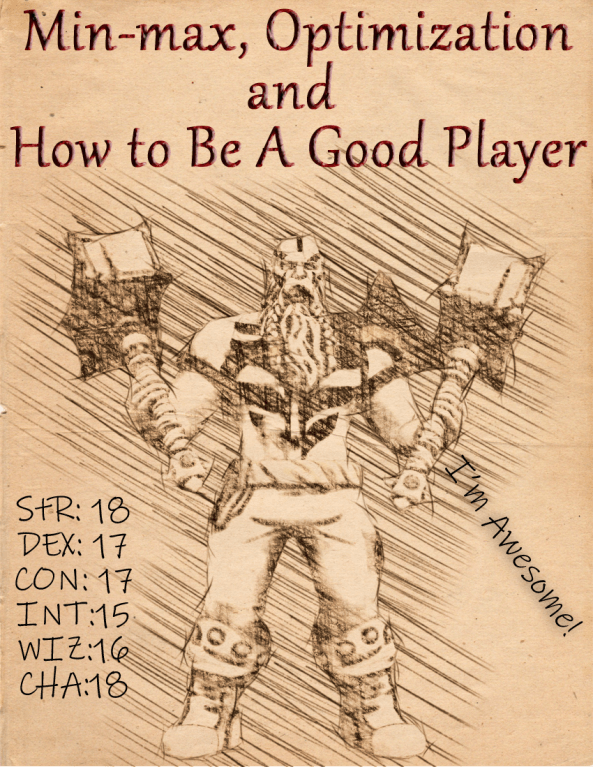
Before we jump into this, let’s acknowledge something. Certain terms within the gaming community have “flexible” definitions. Before I dive into my thoughts on min-maxing vs. optimization and how a D&D game “should” be played, I need to define what these terms mean in the context of this post. You may have a slightly, or wildly, different definition. For the sake of clarity, read over the definitions, and then let’s jump into min-maxing, optimization, and strategic gameplay.
Min-maxing: when a player of a tabletop role-playing game attempts to minimize their character’s weaknesses while enhancing the character’s strengths to their maximum potential with disregard to context or story. This often occurs when a player designs a character based on stats as opposed to playability and enjoyment.

Optimizing: building a tabletop role-playing character up through gameplay and within the context of the story. Initially placing the ideal abilities and scores within the appropriate stats, but then continuing to develop the character based on game and character development.
So the difference is subtle…
Essentially, when you “min-max”, you lay out a path of development you intend for your character before they have reached any developmental milestones. This mostly means your character will develop based on what is statistically advantageous. “Optimizing” builds your character’s abilities within the context of what makes sense for the story and the character themselves.
For example, let’s say a bard wants to multiclass with barbarian. This can be done by either min-maxing or optimizing. What really matters is why and how this happens. If you’re min-maxing, the bard takes a multiclass because they’ve reached a high enough level to multiclass and it will beef up the stats. If you’re optimizing, you take on the second class because the bard just returned home and found that it was overrun by Gnolls. Everyone in town is dead, and now your sweet lovable bard is filled with a fury never felt before!
Is min-maxing bad?

I’m going to kick the kobold’s nest here a little bit and say, no not really…
But there is a caveat to my opinion. Min-maxing doesn’t work at every table. In fact, I would say that the majority of tables don’t promote that kind of gameplay, but not all. That’s one of the beautiful things about Dungeons & Dragons and TTRPG in general; there’s no one way to play them.
Some people play Dungeons & Dragons in space. Some people play a complete homebrew game and pick and choose aspects of other TTRPG to make the mechanics work, and some people are hard-liner RAW* game lawyers. Ultimately, that means there really isn’t any right or wrong way to play the game. It’s more a question of, “does this work?”
There are DM’s that love playing with stats, and they collect players that likewise love stats. Don’t get me wrong, they love the role-playing aspect of the game as well. They love going on adventures in mythical realms, saving the princess/prince, and all that stuff, but their favorite part of the game is the statistics.
When a table full of like-minded people come together and genuinely enjoy figuring out how to play D&D, Pathfinder, or any other crunchy* game, something good is happening in the world. It doesn’t matter that they are focused on the statistics. If the DM enjoys helping the players min-max their characters while trying to do the same with the monsters, then everyone is having fun.
So min-maxing is no big deal?

Well, not quite. The issue isn’t whether or not min-maxing is a good or bad way to play. The issue is whether or not it’s a good fit for the table. Most D&D, Pathfinder, or tabletop RPG tables don’t sit down for hours at a time to crunch numbers. Yes, there is excitement in building a character, but the story is the backbone of the game.
If a player enters a new game and immediately begins to push the boundaries of their character’s stats beyond what is realistic or reasonable, most tables will be annoyed; not all, but most. There DM/GM either wrote a campaign or spent hours reading over a module, and they probably did that so that they can help illustrate a story with the players. Most players come together because they want to tell a character’s story with their friends over the course of several months.
If you walk in and start tinkering with the stats in ways that just don’t make contextual sense, you’re going to ruffle some feathers. No one’s going to blame you for optimizing your character. All players can and should optimize, and let’s be honest, that’s typically going to make sense within the context of continuity.
If someone is going on an adventure, they are going to want to survive it. Unless you’re writing a character that simply doesn’t want to go on adventures but doesn’t have a choice or is suicidal, they’re going to try to optimize their abilities. Who wouldn’t, given the circumstances adventurers typically find themselves in?

But power isn’t the center of most people’s life. Players write an interesting story that they want to see explored and developed. It’s easy to detract from other people’s fun when your play style focuses on different aspects of the game.
So what’s the bottom line?
I say this to every new player, talk to your DM about what kind of table they’re running, what the general tone and attitude of the story is, and how you will best fit into the game. Because there’s so many different ways to play a TTRPG, it’s so important to understand whether or not what you are looking for is at the table you are trying to jump into.
Again, there’s nothing wrong with min-maxing, if that’s what the table is all about, if that’s what they love, then great! That being said, that’s not the norm. Frankly, if that’s what you are looking for, it might be easier to look for a different TTRPG. D&D is a little more focused on adventure role-play, and there are a ton of other types of crunchy games you might end up enjoying more.
Personally, when I play D&D as either the DM or a PC, I’m looking for adventure, intrigue, and story. I love playing with the stats, but that’s not why I sit down. That being said, I play other games that encourage you to maximize your stats. I enjoy those just as much as I do Dungeons & Dragons, but for different reasons.
Think about why you and everybody else have decided to sit down and play the game. If the reasons are different, no big deal. You just need to find a new table to play at. There are plenty out there!
RAW: Rules As Written. This describes a TTRPG play style in which the original rules are upheld without any alterations or homebrewing. It also is used to describe a specific role within the game. “Rules as written, you can’t duel wheeled two great swords. Put one down.”
Crunchy: Referring to games that require a lot of “number crunching”.


Writer
Pingback: Mastering Min-Maxing in RPGs: The Ultimate Guide - Game Stats Wiki - Strategy Guides, Lore & Tier Lists